The Truth About Vanity Publishing

We founded Self Publishing Studio out of a growing unease.
At Lemon Jelly Press, our intention was always clear. We set out to operate as a traditional independent publisher, selecting work with care and paying our authors, even if modestly, because that exchange matters. It signals value. It affirms that the work itself is the product.
Yet, as the press grew, so too did a particular kind of enquiry.
Writers began approaching us not with manuscripts for consideration, but with budgets. They asked how much it would cost to be published, how quickly it could be done, what package might secure them a place on a list. Many arrived having already been quoted significant sums elsewhere, often under the impression that this was simply how publishing now worked.
It was, frankly, disquieting.
What became clear was not a lack of talent or ambition, but a lack of clarity across the industry. Too many writers were being guided towards models that blurred the line between professional service and exploitative practice, often without fully understanding what they were paying for or why.
Self Publishing Studio was created as a response to that confusion.
Not to replicate those models, but to offer an alternative grounded in transparency, fairness, and professional integrity. A place where writers can access high-quality editorial, design, and publishing support without surrendering control of their work or navigating inflated costs disguised as opportunity.
The publishing landscape does not need more noise. It needs greater clarity.
And, above all, it needs places that writers can trust.
Understanding the Publishing Landscape
Before making any decision about how to publish your work, it is worth pausing to understand the different models you are likely to encounter. The language used across the industry can be deceptively similar, but the underlying structures and incentives vary significantly.
Traditional Publishing
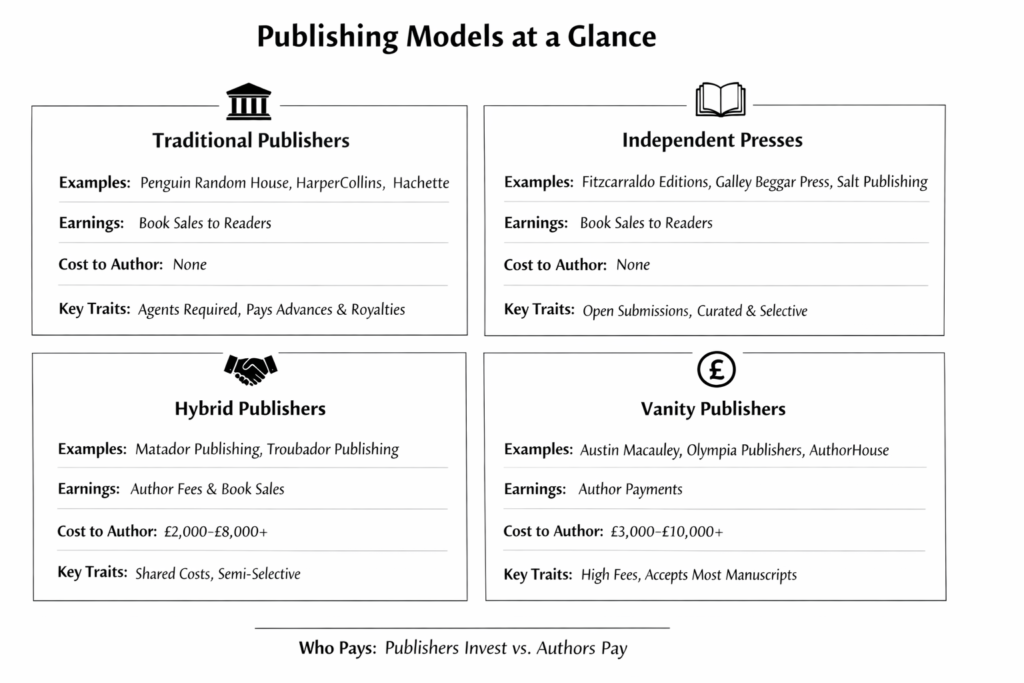
At the top end of the industry sit the large, established publishing houses such as Penguin Random House, HarperCollins, and Hachette.
These organisations operate on a clear commercial principle: they invest in books they believe will sell to readers.
Authors are not asked to pay. Instead, they are typically offered an advance against royalties, and the publisher assumes the financial risk of editing, design, printing, distribution, and marketing.
Access to these publishers is, however, highly competitive. Most do not accept unsolicited submissions, meaning writers must secure representation through a literary agent who acts as both gatekeeper and advocate. The process can be slow, selective, and at times opaque, but it remains the gold standard of the industry.
Independent Presses
Alongside the major houses sits a rich ecosystem of small independent presses.
These publishers often follow the same fundamental model as their larger counterparts. They curate their lists, invest in the work, and pay their authors. The scale may be smaller, advances more modest, and marketing more targeted, but the principle remains intact: the publisher earns from selling books, not from charging writers.
Independent presses are frequently more open to unsolicited manuscripts, offering writers a direct route to submission without the need for an agent. For many authors, particularly those working in literary fiction, poetry, or niche genres, this can be an invaluable pathway into publishing.
Hybrid Publishing
Hybrid publishers occupy a more ambiguous space.
They often position themselves as a middle ground between traditional and self publishing, combining elements of both. In practice, this usually means that authors are asked to contribute financially towards the cost of publication while the company provides editorial, design, and distribution services.
Some hybrid publishers are more selective than outright vanity presses, and they may be more transparent about their fees. However, the fundamental tension remains.
The author pays.
And with that payment comes a subtle but significant shift in the perceived value of the work.
Part of the appeal of a publisher’s imprint is the assumption of curation. A reader sees a publishing logo and, consciously or not, understands it as a marker of quality, a signal that the book has been chosen from many others.
Hybrid publishing complicates this signal.
It is, in effect, a form of branding that may suggest rigorous selection where none can be reliably verified. Placing a respected-looking imprint on a book that has been funded by the author does not, in itself, elevate the quality of the work. It is not unlike affixing a luxury label to a mass-produced garment. The label may alter perception, but it does not change what lies beneath.
The difficulty for writers is that rejection rates and selection criteria are rarely disclosed. It becomes almost impossible to determine whether acceptance reflects genuine editorial judgement or a willingness to proceed based on the author’s ability to pay.
Vanity Publishing
At the far end of this spectrum sits vanity publishing.
Here, the model is unambiguous, even if the presentation is not.
The writer submits a manuscript.
The manuscript is praised, often swiftly.
A contract follows, accompanied by a request for significant financial investment.
Fees can range from several thousand pounds to well over £10,000, with additional costs frequently introduced for marketing, publicity, or “enhanced” distribution.
In many documented cases, authors report paying large sums for services that deliver very little tangible return. Editing may be minimal, design generic, and marketing limited to basic online listings. Promises of bookstore placement or media coverage often prove ill-defined or unrealised.
The pattern is consistent enough to have been widely documented by author advocacy groups and industry watchdogs.
The distinction, ultimately, is straightforward.
- Traditional and independent publishers invest in the book
- Hybrid and vanity publishers rely on investment from the author
Understanding where that financial risk sits is essential.
Because it shapes everything that follows.
The Power of Self Publishing
Amid these different models, it is important to recognise that there is another route entirely, one that places the writer firmly at the centre of the process. Self publishing, when approached professionally, offers something none of the other models can fully provide: complete control. The author retains ownership of their work, their rights, their pricing, and their creative direction. There are no opaque contracts, no surrendering of decision-making, and no reliance on acceptance from an external gatekeeper. Instead, the writer becomes the publisher, choosing skilled editors, designers, and illustrators as needed, and building a book with intention at every stage. It also offers a level of agility that traditional models cannot match. Timelines are shorter, decisions are immediate, and the work can evolve over time. Most importantly, it allows for a direct relationship between writer and reader, one built not on branding or perceived validation, but on the quality of the work itself. When done well, self publishing is not a lesser alternative. It is a powerful, legitimate path that rewards clarity, professionalism, and ownership, and for many writers, it is the most honest way to bring their work into the world.
A Note at the End…
Writers deserve to understand exactly what they are entering into, what they are paying for, and what they can reasonably expect in return. The lines within the industry have become increasingly blurred, but the principle remains straightforward. Your work has value. It should not be diminished by opaque contracts or inflated promises. At Self Publishing Studio, we believe in restoring that clarity. Not by selling a dream, but by offering the tools, expertise, and honesty required to bring a book into the world properly.